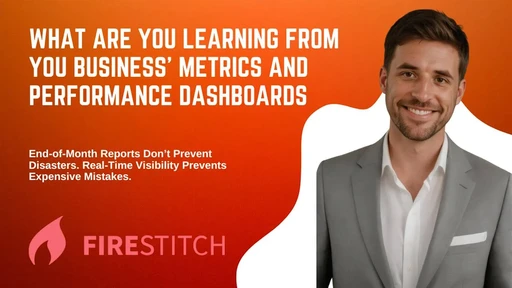
Gain real-time insight into what’s happening across your business without chasing reports or guessing.


Trusted by








Transparent Metrics and Real-Time Visibility Across Your Systems
Organizations rarely struggle because they lack data. They struggle because they cannot see what is happening when it matters.
As systems grow more complex, metrics become delayed, fragmented, or unreliable. Reports arrive after decisions have already been made. Dashboards reflect partial truth. Teams debate numbers instead of acting on them.
FireStitch designs systems that deliver transparent, real-time metrics across operations, revenue, and leadership—so decisions are informed by what is happening now, not what already happened.
This page is not about analytics tools or prettier dashboards. It is about building systems where visibility is embedded into operations, not layered on afterward.
Why Visibility Breaks Down as Systems Grow
Visibility rarely disappears all at once. It erodes gradually as systems evolve independently.
New tools are added to solve local problems. Data pipelines become fragmented. Reporting logic diverges across teams. Over time, metrics no longer align with reality.
Teams rely on scheduled reports instead of live signals. Leadership sees outcomes after the fact, when intervention is no longer possible. By the time a problem appears in a dashboard, the cost has already been incurred.
Lack of visibility creates secondary problems:
Decisions slow down
Accountability becomes unclear
Trust in reporting declines
Teams revert to intuition instead of evidence
These are not reporting failures. They are system design failures.
Common Visibility and Metrics Challenges
Organizations that lack real-time transparency often face the same structural issues.
Data is scattered across systems that were never designed to communicate. Metrics must be assembled manually, increasing delay and error.
Dashboards reflect activity, not outcomes. Teams see counts and totals but lack context around flow, bottlenecks, and risk.
Metrics are role-agnostic. Everyone sees the same numbers, even though decisions require different levels of detail and responsibility.
Alerts are missing or ineffective. Teams learn about problems only after performance has already degraded.
As volume and complexity increase, these gaps widen. Visibility becomes reactive rather than operational.

Real-Time Visibility Solutions Designed as One System
FireStitch services are applied to visibility as an outcome of system design, not a standalone feature.
Operational Dashboards
Custom dashboards reflect live system activity, not delayed reports, providing immediate insight into performance and risk.
Automated Signals and Alerts
Workflow automation triggers alerts when thresholds are crossed or processes stall, enabling early intervention.
Integrated Data Pipelines
Systems integration ensures data flows reliably across platforms without manual reconciliation.
Scalable Visibility Architecture
As systems grow, metrics scale with them without degrading performance or clarity.
Together, these capabilities create transparency teams can trust.
When Organizations Engage FireStitch for Real-Time Metrics
Organizations typically engage FireStitch when:
1
Leadership no longer trusts dashboards or reports
2
Metrics arrive too late to influence outcomes
3
Teams argue over numbers instead of acting on them
4
Operational issues are discovered after impact
5
Growth has increased complexity without visibility
6
Reporting relies heavily on manual effort
These are signals that visibility must be designed into the system itself.
Are you experiencing any of these pain points?
Related Insights and Resources
Explore related content on building systems with reliable, real-time insight:
1
Operational visibility and metrics articles
2
Workflow automation and alerting strategies
3
Systems integration and data architecture posts
4
UX design for analytical and operational tools
These resources deepen understanding of how transparency supports control and scale.
Frequently Asked Questions
What does visibility and control mean for operations?
Can you build dashboards from multiple systems?
What if leadership doesn’t trust current reports?
Can you track SLAs and performance across teams?
Do you build “single source of truth” systems?
Book FireStitch Office Hours
FireStitch Office Hours are free, one-on-one strategy sessions with FireStitch CEO Keith Seim and senior FireStitch strategists. These sessions are not sales calls. They are working conversations designed to help us understand your business, review your current systems, surface bottlenecks, and talk through realistic paths forward. The goal is simple: clarity. You’ll walk away with a better understanding of what’s holding you back, what’s possible next, and whether FireStitch is the right fit to help you get there no obligation either way.